
Heart Space Experience
The body is the temple of the Divine, and the heart is the altar.
Living an Authentic Life
Heart Space Group
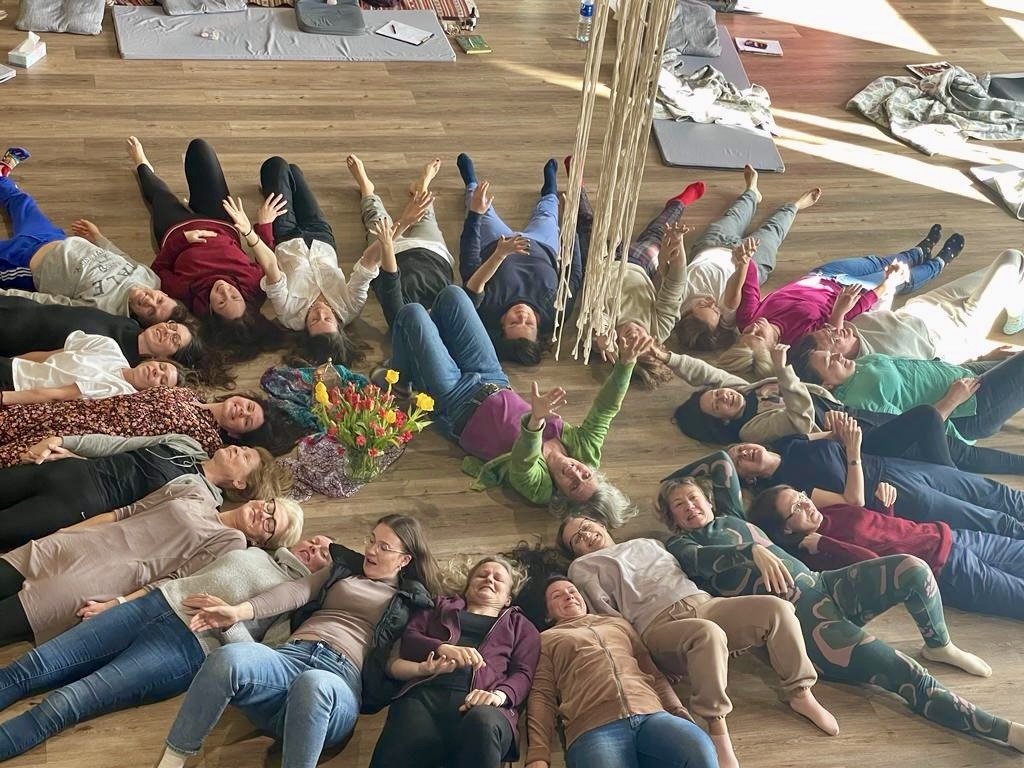
In a group, you become part of something greater and witness the unfolding of other people’s inner processes. Our lives are deeply shaped by relationships, and no one is free from the difficulties that can arise within them. From an early age, we develop different strategies to cope with the challenges of our original family system. Within the group, we can explore these patterns and discover whether they are still relevant to our lives today.
In an ongoing, continuous group, profound and lasting changes can unfold.
Heart Space
The Philosophy Behind the Work
The heart is the center of our being. The space of the heart opens into unknown dimensions. Let us enter and explore them!
Medical Research
Our heart has a complex intrinsic nervous system containing around 50,000 nerve cells. Among them are cells that were previously thought to exist only in the brain, including glial cells. The heart’s own neural network communicates bidirectionally with the brain, with the vagus nerve playing an important role in this communication. There are significantly more signals travelling from the heart to the brain than in the opposite direction.
The heart has an electromagnetic field that is 60–100 times stronger than that of the brain. All of this can be measured. It is the strongest rhythmic field in the body, extending far beyond the physical body into the surrounding space. Studies suggest that it may transmit information between people, with this process being influenced by our emotional state. There is also speculation that the heart may have a form of its own memory. (HeartMath Institute)
Religion
In most religious traditions, the heart holds a central place.
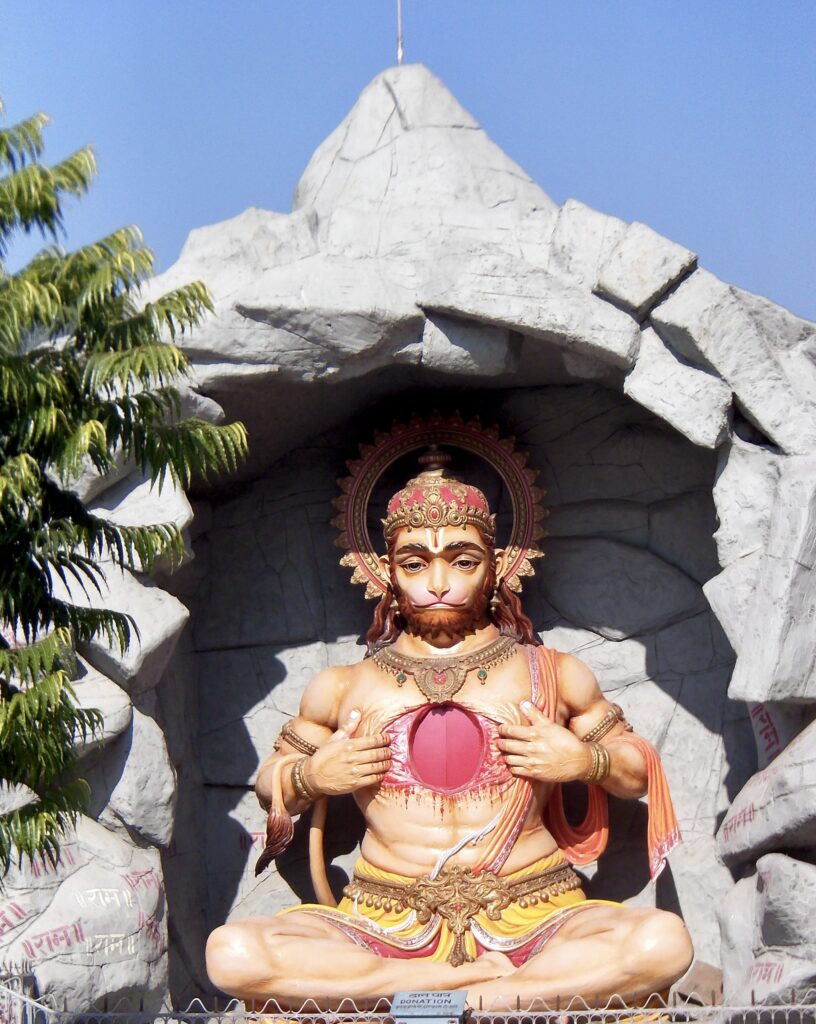
I vividly remember crossing the Ganges in India on a suspension bridge and passing a statue of Hanuman. The monkey god has torn open his chest, revealing a pulsating heart within. A gigantic statue standing in the middle of the river – an image that left a lasting impression on me.
The meditation on compassion is central to Buddhism. Om Mani Padme Hum – the union of compassion and wisdom – is repeated countless times throughout a lifetime. Countless stones have been inscribed with this mantra, carrying its vibration into the material world.
“Love your neighbor as yourself” is a central teaching of Christianity, bringing love of others and self-love together. Mary is not infrequently depicted with a radiant or pulsating heart.
“In the name of the Most Gracious, the Most Merciful” – bismi ʾllāhi ʾr-raḥmāni ʾr-raḥīmi – these are the words with which almost every surah in the Qur’an begins. Religion and spiritual paths across many different traditions remind us, through countless examples, of the central importance of the heart. Surely, this is not without reason.
What if?
What if we consciously chose to bring our attention to this center? From the head, down into the heart. And from there, into life.
“We see clearly only with the heart.” This often-quoted statement from The Little Prince may seem simple at first glance. Putting it into practice is not always easy. In the heart, we experience feelings such as affection, empathy, compassion, love, gratitude, connection, joy in being alive, and ecstasy.
We do not think these feelings. We feel them in the deepest part of ourselves. What would a world look like that is not oriented around the head and the brain, but guided by the heart?
In an increasingly technological world, our capacity to feel is gradually being pushed aside. It is somewhat like the loss of biodiversity.
Our feelings can become dulled by the constant flood of emotions we encounter, for example through social media. We lose our sense of perspective and, with it, our direct access to our own hearts. News and events from all over the world continually pour in on us. What is often missing is direct, heart-to-heart contact between people – and this can gradually lead to a kind of emotional impoverishment.
Sexuality & Relationships
I
In Tantra, we work with an understanding of the body as a magnetic field. In this view, the positive pole in women is located in the heart, which is considered their central source of power. In men, the positive pole is associated with the genitals.
Tantra teaches that men can receive women’s feelings through the heart, which is understood as the receptive, negative pole of the magnet. In women, the receptive negative pole is associated with the womb and pelvis.
Unfortunately, our history gets in the way here. For thousands of years, men have been sent to war. And I ask you: how can you keep your heart open when you are killing, torturing, dismembering, abusing, or raping another human being? It doesn’t work.
It is similar for women. How can a woman open her womb with ease when women have been oppressed, mutilated, raped, abused, violated, and sold for thousands of years – and still are today?
In this way, we as humanity have found ourselves in a profound dilemma. We stand before one another at closed gates. It takes an enormous amount of patience, compassion, and understanding to meet each other in depth, without being distracted by our difficulties or even overwhelmed by them.
We were never taught about attachment and relationships at school. Nor at university. As a couples therapist, I am deeply familiar with this dilemma. At heart, most people long to be close to one another and to love. Yet very few people know how to do this. Countless obstacles arise along the way, and we need to learn how to face them.
“Behind all hatred, disappointment, fear, and other negative emotions lies an innate sense of well-being. This divine quality returns when suppressed feelings are allowed to surface and leave the system. For behind hatred lies love, and behind mistrust lies trust.”
– Gerda Boyesen
The Collective Level – Reconnecting with Our Hearts in Times of Patriarchal Wounds
The patriarchal world is characterized above all by self-centeredness, rivalry, competition, power struggles, and separation. “America First” is a clear example of this.
Reconnecting with the positive feminine principle – our heart – is essential not only for women, but equally for men. Only together can we grow beyond our collective patterns and wounds.
From psychotherapy, we know that every trauma needs attention and compassionate presence, rather than turning away from it, which only reinforces or displaces it. The same applies to collective trauma.
We need courage, space, and time, as well as a compassionate presence, to turn towards our own hearts. For the heart is often covered by defenses and compensatory patterns that protect us from feeling the immense pain and trauma held within both our personal and collective experience.
Shock, fear, melancholy, nervousness, inner unrest, and emotional pain are often difficult to bear. Especially when we are alone with these experiences, they can become retraumatizing. We can find ourselves spiralling further downward. Hatred, self-hatred, substance abuse, violence, humiliation, suicidality, murder, and killing can follow.
Apathy, emotional dullness, and numbness are further expressions of the inability to feel. And these brutal energies are by no means directed only against ourselves. They can also be turned against other people, ethnic groups, and those who are more vulnerable. Women are a frequent target of such violence in our world. Sexism and gender-based violence are characteristics of patriarchal structures.
The absence of the heart is also reflected in the way we treat animals, plants, Mother Earth, and life itself. Here, too, aggression is directed against the feminine, life-giving principle.
SOMETHING MORE
It’s About Something Greater
We are not on this Earth at this particular time without reason. You are not reading this by chance.
It matters
In these difficult times of upheaval and global crises, it matters that all the wonderful capacities of a warm and compassionate heart are brought into the world. The system needs balance.
S
Even when no one knows about it, when our hearts quietly resonate with compassion, love, and gratitude, it has an effect on the larger field around us. The people closest to us, in our families and everyday lives, benefit from it. A present and deeply felt inner attitude finds its way into our work and into the way we relate to the world around us. A gentle sense of relief and relaxation begins to emerge.
Our world needs a turning towards a culture of giving and care, rooted in connectedness.
What Do We Need to Feel?
Sometimes it can be helpful to spend some time alone. Most often, however, genuine human contact with someone who truly sees us and with whom we feel felt can be deeply supportive. A sense of safety and security plays an important role.
Layer by layer, we begin to let go of the armor, shields, blocks, and embodied defensive strategies that have formed around our hearts. Shell by shell, we peel away the layers to reveal what has been hidden underneath.
For me, this work is about much more than therapy. In psychotherapy, we have learned to work with the obstacles of the psyche. In meditation, we practice calming the mind. In the Heart Space, a more relaxed and secure heart can open and embrace the pain. We increasingly remember our human potential.
In the space of the heart, it becomes possible to attune ourselves to a much greater dimension and to experience it through our own felt awareness. Within this expanded field, the true capacities of being human can begin to unfold, as research by, for example, Joe Dispenza suggests. A space opens up in which miracles can occur.
In my work, I accompany people in reconnecting with their innermost selves. This may happen through having space entirely for themselves – as in a retreat, meditation, mindful movement, or creative play – as well as through discovering new experiences in kind and supportive interaction with others in a group.
There is something deeply nourishing about being truly seen, heard, and felt by another person.